

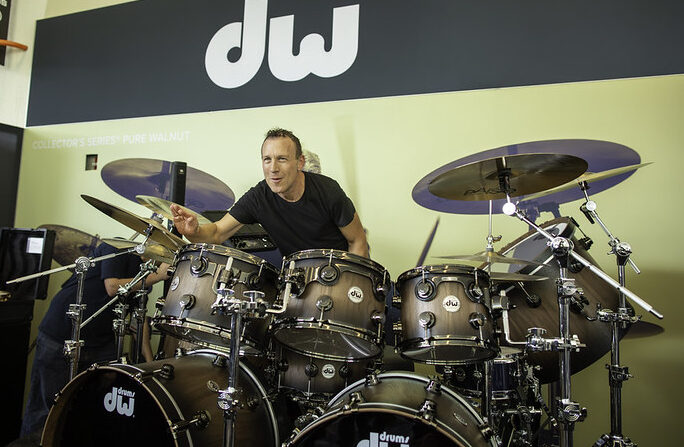
Finding the Drum Hook: How Stephen Perkins Makes Drums Part of the Song
Please enjoy this article where Stephen Perkins discusses how drums fit into a song and how they can become a hook of their own.
When you think about the word “hook,” it’s something you get hooked on that you want to hear over and over, but it’s also something unpredictable, like when a fish gets hooked. Everything’s fine, and all of a sudden you’re hooked. I think of it both ways: you want to give them something unpredictable, but after hearing it over and over, it becomes predictable, and that’s the hook.
If I can find my place in those little spots and find my hook among the hook of the bass player, the guitar riff, and the poem, that’s it. That was the magic of “Mountain Song.” The groove itself is very tribal. You can play it on a djembe or a conga, and then when you transcribe it to a drum set, you can figure out how it works. It’s very simple, but it’s a complicated idea. One of the great drummers of all time, Kenny Aronoff, called me up because he was doing a gig where they were covering “Mountain Song.” He said, “I’ve got the beat, but it doesn’t sound quite right.” I said, “Think of it as a djembe beat, not a drum set beat,” and he got it.
I’m always trying to find a spot that doesn’t interrupt the tune. You always heard Ringo say you don’t want to mess with the song, but how do you figure that out when you have a poem, a bass line, a guitar riff, maybe some piano, and a production?
One of my favorite Ringo beats is “Tomorrow Never Knows.” That’s a feel. That’s a drum hook. I want to write hooks like that. I played five and a half years on pillows and practice pads. From 1977 to 1982, I really just played pads and pillows. That’s where you get the chops and learn how to work your hands, and find that romance between the stick and your hand. When I got a drum kit, I had to relearn the whole thing, because your feet have to work with your hands, and these great rudiments have to live in different places. But it starts with the pads.
For “Mountain Song,” it’s the hand pattern that makes all the difference. With rhythm, it’s not what you do, it’s what you don’t do. It really has to be a feel. I always think of it as an oval shape going down a hill. That egg will get to the bottom, but it has a hump to it, and that’s what this beat’s got. The second section of the song, or the “B” part, really swings and gives the groove its distinctive feel.
I was a big fan of heavy metal and kind of fell out of it, and then Pantera showed up, with the great Vinnie Paul on drums, and it was the drummer that pulled me back in. The same thing happened with Slipknot. It doesn’t have to be the song; it can be the drummer. I’m an athletic person. I like to see athletic drumming. When you think about the choices those drummers made and the environments they grew up in, that’s what made them sound that way.
For more with Stephen Perkins, check out his Masterclass on Drum Channel!