

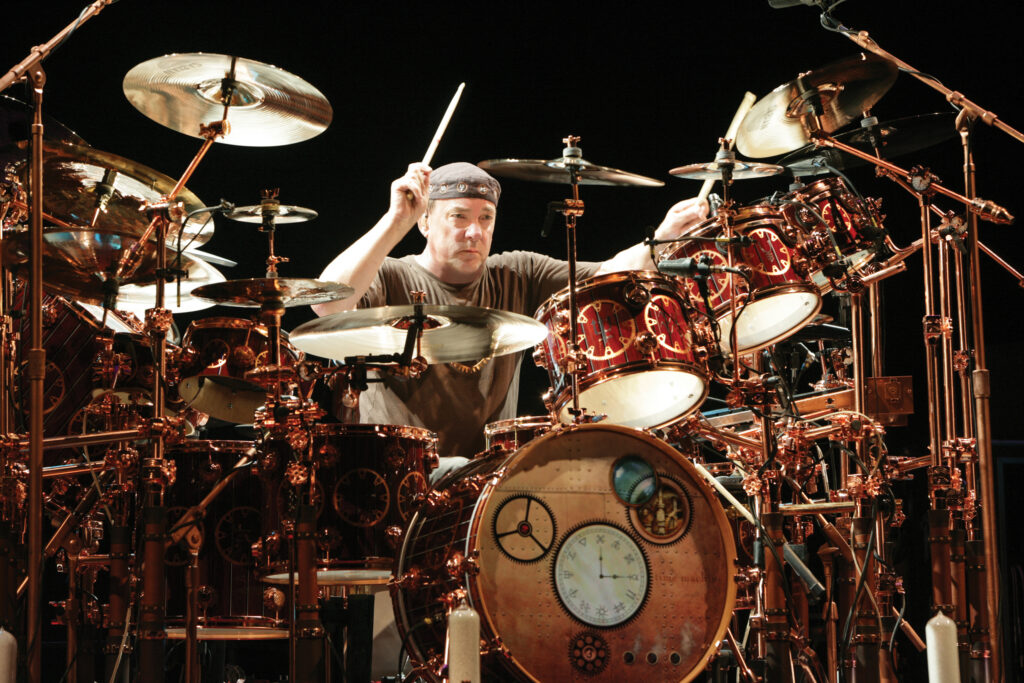
Neil Peart on Staying Curious: Why Growth Never Stops for Great Drummers
At the highest level of musicianship, growth never stops. Even after decades of mastery, Neil Peart continued to push himself, experiment, evolve, and stay uncomfortable. He viewed performance not as repetition, but as exploration.
Neil once shared why his solo in “De Slagwerker” was so important to him. Below is an excerpt about staying curious from his Drum Channel course, Frontiers of Composition and Articulation.
“When this De Slagwerker was conceived, I wanted to make as many changes as I could for the next tour and recording. I had decided that, as a soloist, I was more of a composer than an improviser. I wanted to be an improviser, so having drawn that paradigm for myself, I was determined to push myself to improvise more in my solo.
I decided that the opening large part of the solo on the acoustic drums would be improvisational. I would deliberately start with a different figure every night. Sometimes during my warm-up before the show, I would come upon something and say, ‘Okay, I’ll use that tonight.’ Oftentimes, I’d be standing backstage just before we went on, considering, ‘What figure should I open with tonight?’
For example, we were in London, Ontario, so I opened with ‘Wipe Out’ because that was the first song I ever learned to play on the drums. I started playing drums on my 13th birthday, so as a tribute to that, I used ‘Wipe Out’ that night. When we started playing indoors in hockey arenas, I began thinking of hockey themes.
I’ve often said that the solo, for me, is a bit of an exploratory vehicle during the concert, where I can work on new things that eventually I’ll master and be able to use in songs. I am really trying very hard every night to make it as different as I can, while still allowing the satisfaction of patterns that I had stumbled across quite purely. I would think, ‘Oh, that’s nice,’ and of course, the next night it would come back because I liked it.
One thing that I did for the opening part was build it on a different kind of ostinato, one that I’ve been using for many years and talked about a lot based on Max Roach’s ‘The Drum Also Waltzes.’ Some days, I could get that pattern going and play very freely over the top of it and forget about my feet. I’m trying to be as free as I can, again playing all those different time signatures and patterns.”
To enjoy the full course, click here: Frontiers of Composition and Articulation.